

Thailand SMR Licensing: Certify Once, Deploy Everywhere
The most valuable thing a regulator can offer a hardware company is not speed. It is reciprocity — the willingness to accept another competent regulator's work instead of repeating it.
In our final Nuclear-AI Nexus session, the official responsible for Thailand SMR licensing said out loud what most deep-tech founders spend years hoping to hear. It is worth understanding precisely what was offered, and what it was conditioned on.
The gap is arithmetic, not ambition
Dr. Bancha Yathip, Energy Advisor and founder of 89 Plus Energy, laid out the Eastern Economic Corridor's problem in plain numbers. On top of roughly 5,600 MW already in place, AI hyperscalers need an additional 500 MW.
His assessment: "That is a really massive amount of power to supply, and we cannot supply it."
The constraint is distribution, not generation in the abstract. PEA owns the distribution area, and, in his words, "our substations do not have enough power to supply hyperscale AI data centers." For the initial demand across four cloud data centre locations, the ceiling is about 60 MW per location. Against demand he characterised as "very, very aggressive," his estimate of what the corridor actually requires is 5,000 MW within five years — across Chonburi, Rayong, and Chachoengsao, three provinces already dense with heavy industry.
He was careful that this is not an argument for moving fast. "It must be done step-by-step, through public hearings. We must be humble and respect the people in those areas."
From our side of the table, I made the case that data centres are not the only driver, and founders reading demand signals should understand the full stack. Energy independence is a national security question: geopolitical conflict puts every Southeast Asian country at existential risk without it. Growth compounds it — Vietnam is targeting roughly 10% GDP growth over the next five years, which implies electricity demand rising 12 to 15% annually. And sovereign AI initiatives are making localised compute a matter of national strategy, where reliability is non-negotiable for mission-critical workloads such as banking, emergency response, and sovereign cloud.
The urgency for SMRs is really an urgency for firm, low-carbon baseload. SMRs sit at a rare intersection of scale, density, and clean weather-independent generation without the fragility of batteries or deep cycling.
What passive safety actually buys you: 16 kilometres down to two
Somjait Sudprasert, Director of the newly established SMR Regulatory Division at Thailand's Office of Atoms for Peace, explained why the safety case translates into a siting case — and he did it with the clearest analogy of the entire series.
Core damage frequency for a conventional nuclear plant runs between roughly 10⁻⁵ and 10⁻⁶. His comparison: "that 10 to the minus 6 is the probability that you go out in the rain and get struck" by lightning. For SMRs, "the developer claims that the CDF is less than 10 to the minus 7 — so really low." His analogy for that: "it is quite similar to an airplane crash — you can imagine how unlikely it is for a commercial airplane to crash."
Note that he said the developer claims. A regulator maintaining that distinction in public is a signal about how the review will actually go.
The consequence is spatial and it is large. A conventional plant requires an emergency planning zone of about 16 kilometres in diameter, with evacuation and sheltering planning for every household inside it. For SMRs, "we can reduce the zone from 16 kilometers to 2 kilometers from the reactor building. That means you can put an SMR on a smaller site, such as an industrial estate."
He also drew the generational line precisely. Gen 3+ designs use light water — fresh or sea — as coolant, NuScale being his example. To reach 10⁻⁷, "it needs to be Gen 4 or Gen 3+. Gen 4 is better, because those designs no longer use water to cool the reactor; they use molten salt or liquid metal as the cooling agent." That is what permits siting inside a populated industrial estate.
For founders in any regulated hardware category, the structure of that argument is the thing to copy: a design property (passive safety) produced a quantified risk reduction (10⁻⁶ to 10⁻⁷), which unlocked a regulatory concession (16 km to 2 km), which created a commercial capability (siting next to the load). Each step is legible and each is auditable. That is how you convert engineering into permission.
The offer at the centre of Thailand SMR licensing: trust the vendor's regulator
Asked about review timelines, Somjait began with policy intent: "our policy is not to make regulation a barrier to the development or deployment of SMRs."
Then the mechanism. If a design has been certified by the regulator of the vendor country — with the technology proven through heavy quality-assurance testing at a testing facility, and the result guaranteed by that regulator — OAP will lean on that work rather than duplicate it. His framing of the underlying problem is exactly right: "every developer or technology owner claims their design is safer. So how do you prove it?"
The Thailand SMR licensing timeline, as it could be
The timeline compression he described, offered explicitly as his own current opinion rather than settled policy:
Siting licence: two years under existing regulations, potentially compressible to one year, because the reduced emergency planning zone simplifies the review
Construction licence: three years under existing requirements, potentially 18 months if the design is already approved by the vendor country's regulatory body
He grounded the trust in institutional relationships rather than sentiment. OAP collaborates with the US NRC and EU regulators "almost every day," rates Chinese regulators as highly competent, and has signed MOUs with the US, China, and Korea. His logic: "The lecturers and regulators from the vendor country are very familiar with their own technology — its flaws, its advantages, and what should be focused on." And on why any of this urgency matters to him at all: "We know that time is money when you take a loan from the bank."
Siting risk in Thailand helps. As he noted, the country does not face many earthquakes, tornadoes, or tsunamis — "we are in quite a safe area."
Somjait was also candid about his own institution's limits, which is worth recording. On workforce, OAP faces a retention problem: train inspectors to competence and "they will leave for the private sector, which offers more benefits." On structure, he said OAP plans to review whether it remains appropriate for the agency to sit within a ministry, because "from an international point of view, it is not independent enough." A regulator naming its own independence gap is, counterintuitively, a credibility signal.
Dr. Kampanart Silva of ENTEC clarified the permitting map for anyone planning to actually file: nuclear-island permitting sits with OAP; once you exit the nuclear island, it moves to the Energy Regulatory Commission. PEA and MEA "are basically only the operators of the transmission lines." PPA decisions also sit with the ERC.
Do not oversell the economics
The most useful contribution of the session was a correction, delivered by Kampanart against the prevailing narrative — including, to a degree, against ours.
He began by separating two things that get conflated: economic viability and financial viability. Then he addressed the claim that nuclear is cheap:
"Many people say nuclear power is cheap, and that is one of the motivations to go nuclear. I would say that may not be so true for SMRs. The LCOE for SMRs will not be that low — especially in Thailand, where the cost of electricity is currently about 4 Baht per unit. So I do not believe that, especially for first-of-a-kind SMRs in Thailand, we can get down to that figure."
His path down the cost curve is the economics of multiples — distributing investment across ten or more modules — which "will bring down the LCOE in the future, but it still won't be that low."
What makes the business case work instead is not price but two other properties. First, carbon: emissions reduction enables exports to carbon-conscious regions, and "quite a number of investors and industries are willing to pay a bit more per unit in order to be able to export to those carbon-conscious regions." Second, reliability: "we also need power that we are sure will be there 24/7, even if it is a bit more expensive."
His conclusion is more encouraging than the numbers suggest, and more disciplined:
"There are promising business cases for SMRs starting now. We don't need to wait until the 10th or 20th SMR, but we will need to find the right customer and the right financial model."
Elsewhere he was blunter about segmentation: "Personally, I don't believe SMRs are suitable for all customers, so we need to find the correct customer segment and the correct financing scheme."
Founders should sit with that. A researcher who models the cost of your technology is telling you that your product is not cheaper and should not be sold as cheaper — it should be sold on firmness and carbon to the specific buyers who price those attributes. Choosing the customer who values your actual advantage beats improving a cost story that will not win.
Kampanart also outlined the scientific prerequisites Thailand is working through, drawn from his work on the country's science, technology and innovation framework. His structural insight: STI milestones must run ahead of IAEA project milestones, "so they can support decision-making at each stage." The pillars needing deeper study include passive safety (uncommon in Gen 2 and therefore unfamiliar to operators), funding and financing, radioactive waste management — Thailand has substantial experience with low- and medium-level waste through the Thailand Institute of Nuclear Technology, but not spent fuel or high-level waste — emergency preparedness, and design selection among what he counted as 60 to 70 SMR designs currently in the field.
Two problems the market has not solved
Dr. Bancha identified where Thailand's market liberalisation is genuinely stuck. The Direct PPA framework, currently under public hearing at the ERC, is in his view "the right tool at the right time — a sandbox solution for hyperscale AI data centers." Investor concerns are specific: third-party access, the wheeling charge, and imbalance penalties. On the last of these he gave a concrete number — at 4.2 Baht, a double penalty means 8.40 Baht per kilowatt-hour. "That is a big penalty."
Volume is the other issue. Two thousand megawatts is allocated for the first pilot; his expectation is that DPPA volume could eventually reach 10,000 MW.
Then land. EEC land now runs from a minimum of 4 million Baht per rai up to 10 million in some areas — too expensive for solar farms, though still workable for battery storage. His conclusion is that hybrid SMR-plus-renewables deployment should look beyond the EEC to special economic zones near Thailand's borders: Kanchanaburi, Chiang Rai, the south. His siting priority is the southern region first, where 14 provinces draw 3,500 MW from distant generation with no large combined-cycle plant, then the northeast.
One number worth holding onto, because it makes the unit economics legible: a Tier 3 data centre requiring 115 or 120 kV needs roughly 300 MW — "equal to one 300-megawatt SMR." One reactor, one campus. That is the sizing logic the whole market rests on.
And his non-negotiable, repeated across two separate answers: siting "must be public, and 100% fully accepted by the local people."
How this gets financed
Asked how the BuildCo/OpCo separation reduces adoption barriers, I made the point that hyperscalers want electron rights, not reactors. They need reliable, safe, affordable energy; they do not want to become nuclear operators, because operating an SMR plant requires expertise and capacity they have no reason to build.
Under a separated structure, the BuildCo develops and constructs the plant and absorbs the licensing and construction risk — the first-of-a-kind risk typically borne by venture investors, and in practice often family offices with the appetite for it. The OpCo side goes to infrastructure funds, which acquire the plant once it is operational and steady, for long-term returns from contracted power sales. This is a conventional large-infrastructure financing structure, very similar to wind and solar. Under nuclear-as-a-service, the developer retains ownership and delivers power under a very long-term contract, and the data centre operator gets predictable 24/7 pricing without construction risk, ownership, or regulatory exposure.
On bankability, two things matter and they are sequential. First, a foreseeable offtake contract, which guarantees future income and becomes the collateral against which a bank will fund construction. Second, replication and fleet-scaling: once one plant is operating, it serves as the reference that lets a bank greenlight the next. The first unit buys the financing for everything after it.
What market entry actually requires
There are only two operating SMRs in the world today — one in China, one in Russia. Everyone in this market is co-evolving.
Against that, the mistake I see foreign developers make repeatedly is treating technology readiness as sufficient. The right cross-border partnership is with a local market-entry partner — an organisation that has spent years building framework, knowledge, and network, that can navigate the politics, the regulators, and the cultural context, and that could ideally serve as the offtaker as well. Technology readiness alone is insufficient in a relationship-driven market, and most of Asia is a relationship-driven market.
We have invested in two SMR companies, one in the United States and one in Sweden, and the reason is the standardisation thesis: SMRs are being built serially, the way cars came to be built. If you can certify one reactor, you can use it everywhere. The corollary is that the contracts should standardise too — term sheets and regional vendor-qualification programmes that cut transaction friction and let projects replicate across provinces and borders. A harmonised regulatory framework, where qualification in one market carries into another, is the version of that idea Somjait has already begun to operate unilaterally.
Third, training. Working with experienced regulators in the US and Europe builds the regulatory muscle that does not yet exist in the region. Somjait's own history illustrates the mechanism: he spent three months at the US NRC in 2005, and observed at the time that hundreds of Vietnamese technical staff were being trained in the United States for that country's programme. His proposal now is that if a vendor's technology is selected, the regulator trains in the vendor country alongside the operator.
One technical question from the audience deserves a note, since it comes up often. Can SMRs improve bankability by selling heat and steam to hard-to-abate industry? In physics, yes — fission produces steam. But the fission reaction also produces radioactive waste, so using heat and steam from the secondary loop requires guaranteeing to a very high standard that the steam is not contaminated. The answer is yes with caution. Most reactors today produce electricity only.
Public trust is a conversation, not a curriculum
Kampanart's closing answer reframed something the industry consistently gets wrong, starting with the vocabulary. He deliberately avoids the phrase public acceptance: "creating acceptance basically means going to educate people and then making them accept. No — we need to understand what their perceptions are, then engage them and bring them into the decision-making process."
His evidence that the ground has shifted is disarmingly ordinary. Ten years ago, nuclear meant bombs and accidents. Now: "when I talk to one of my nieces, she already knows what an SMR is without ever hearing it from me."
Which changes the task entirely:
"If we are going to build public trust, it is not about educating them so they understand correctly what an SMR is — they already know themselves. What we really need to do is have conversations with them."
His practical prescription is message discipline across institutions: "It can't be that I say SMRs are expensive and then Mr. Somjait comes and says SMRs will be cheap — that won't work." And his honest bottom line: "there is no shortcut to building public trust. We need to spend time, talk to people, listen to their concerns."
The transferable lesson
Thailand's regulator is offering something specific: it will trust a competent foreign regulator's certification, and compress its own review accordingly — potentially from five years of combined siting and construction review down to roughly two and a half. That offer is conditioned on evidence, not enthusiasm: proven design certification, documented QA testing, and a vendor-country regulator willing to stand behind the result.
For any founder in a regulated hardware category, that is the shape of the opportunity worth pursuing. Do not chase the market with the largest demand. Chase the jurisdiction whose regulator will accept work you have already done somewhere else — and then make sure the work you have already done is documented well enough to be accepted.
The reactors will get built where the paperwork travels.
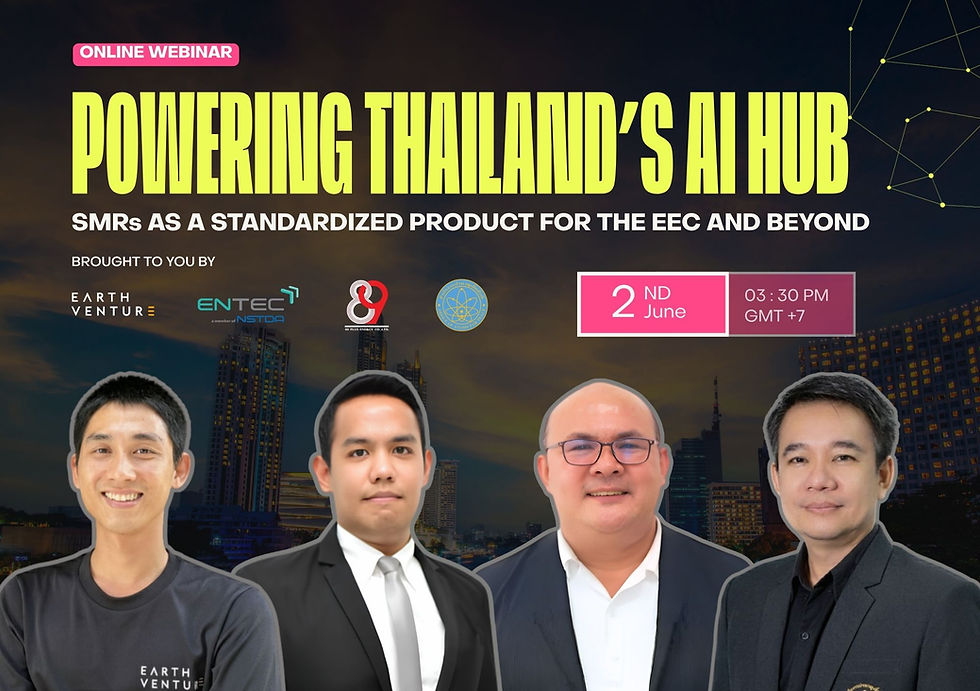
This article draws on Earth VC's webinar "Powering Thailand's AI Hub: SMRs for the EEC and Beyond," the final session of the Nuclear-AI Nexus series following our March 2026 report, Nuclear Energy Fuels AI Boom in Southeast Asia Data Centers. Licensing timelines described by Mr. Somjait Sudprasert were offered as his personal assessment rather than settled OAP policy.
All quotes verbatim from the timestamped transcript. Moderated by Anne Truong, Community & Program Associate of Earth Venture Capital. Panelists quoted: Somjait Sudprasert (Director, SMR Regulatory Division, Office of Atoms for Peace), Dr. Bancha Yathip (Energy Advisor & Founder, 89 Plus Energy), Dr. Kampanart Silva (Researcher, ENTEC).


Comments